• Skip to main content
  • Skip to primary sidebar
  • Skip to footer

American Guild of Organists

iMIS Site

Last Modified on November 16, 2017

North Central: Focus on German Organ Music

Greetings from the North Central AGOYO,

This month we are focusing on German Organ Music! This post will briefly discuss both the North and South German organ schools. Along with recordings, a few composers from each school will also be highlighted.
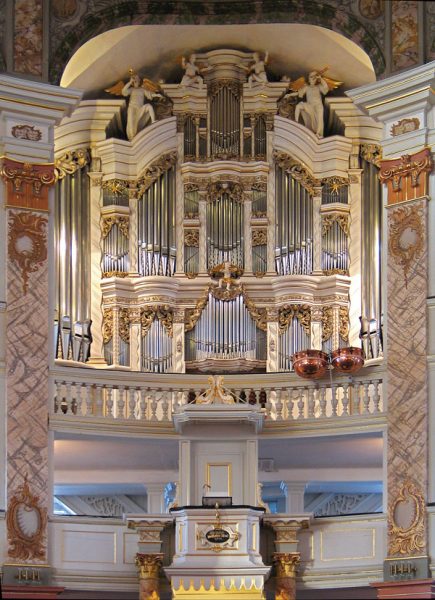
Photo: The Trost organ of Waltershausen, with its 47 stops and 6 transmissions, is the biggest baroque organ in Thuringia. It is largely preserved in its original state of 1730 (a good 70% of the pipe material was built by Trost) and therefore is an invaluable reference when performing organ music by J. S. Bach and his contemporaries. Today this organ is viewed as the most authentic “Bach organ”. (www.organartmedia.com)

German Organ Schools

North German – organ preludes and chorale fantasias are developed. Organ building began to vastly improve by including two or more manuals, a pedal board, and a wide range of stops.

  • Interestingly, Dutch composer, Jan​ ​Sweelinck​ is considered the founder of the North German organ school. His variations on Mein junges Leben hat ein End’ are part ofstandard organ repertoire.
  • The works of Dietrich​ ​Buxtehude​ are regarded as the pinnacle of this tradition. His organ works are cherished by organists; young and old alike. His chorale prelude on Wie schön leuchtet der Morgenstern is a favorite for the Epiphany season.
  • One cannot discuss German organ music without the extensive contributions of Johann Sebastian​ ​Bach​. His tireless work went largely unnoticed during his lifetime and was not appreciated until after his death. What a gift to the church! I include my favorite work, Prelude and Fugue in E Flat Major, BWV 552.

South German – limited stops used, no pedal; much like Italian music. This music focused on the melody, harmonic clarity and sound; while having an improvisatory nature.

  • Johann​ ​Froberger​ is noted as the first important composer of the South German organ school. Froberger visited Italy and France (under the influences of Frescobaldi and de Macque) in order to perfect the craft of his compositions. His toccatas are widely used in programs throughout the world.
  • The city of Nuremberg was graced with the talents of Johann​ ​Kindermann​ ​during the first half of the 17th century. His example of a chorale fugue would later serve as a model to both Bach and Pachelbel.
  • The peak of the South German organ school is attributed to Johann​ ​Pachelbel​. While a majority of his works are secular in nature, Pachelbel continued to develop the chorale prelude and fugue. In honor of the 500th anniversary of the Reformation, we listen to a recording of his setting of Ein feste burg.

Primary Sidebar

Footer

Lessons for the New Organist

Connect

  • Facebook
  • Instagram
  • LinkedIn
  • Pinterest
  • Twitter
  • YouTube

Search

Search help:

Put double quotation marks around multi-word searches. Hit Enter to process.

Mission Statement

The mission of the American Guild of Organists is to foster a thriving community of musicians who share their knowledge and inspire passion for the organ.

Achievement Awards
AGOYO
Antitrust Compliance
Ask the Organbuilder
Change of Address
Chapter Deans Contact
Chapter Documents
Chapter Liability Insurance
Chapter Toolkits
Classified Ads
Contact Us
Find a Job
Find an Organ Teacher
Guild Documents
Insurance for AGO members
Pipe Organ Encounters
Post a Job
Privacy Policy
Salary Guidelines
Strategic Growth Plan

PROFESSIONAL LINKS

Organbuilders & Associations
OrganLive
Other Organ and Choral Music
Other Professional Associations

Pipedreams
Vox Humana

Don’t Fall for Scams

Scammers are everywhere and chapter officers need to be vigilant. Don't respond to requests to send funds unless you know for sure that the request is valid.
American Guild of Organists 475 Riverside Drive, Suite 1260 New York, NY 10115
Hours of Operation: 9 a.m. - 5 p.m. M-F ET
Phone: (212) 870-2310
Email: info@agohq.org
© 2024 American Guild of Organists
Major support for this website was provided by the New York City AGO Chapter’s Centennial Millennium Fund.
GDPR CONSENT: The American Guild of Organists uses cookies on this website to give you the most relevant experience by remembering your preferences and repeat visits. By clicking “Accept” you consent to the use of cookies.
Cookie settingsACCEPT
Manage consent

Privacy Overview

This website uses cookies to improve your experience while you navigate through the website. Out of these, the cookies that are categorized as necessary are stored on your browser as they are essential for the working of basic functionalities of the website. We also use third-party cookies that help us analyze and understand how you use this website. These cookies will be stored in your browser only with your consent. You also have the option to opt-out of these cookies. But opting out of some of these cookies may affect your browsing experience.
Necessary
Always Enabled
Necessary cookies are absolutely essential for the website to function properly. This category only includes cookies that ensures basic functionalities and security features of the website. These cookies do not store any personal information.
Non-necessary
Any cookies that may not be particularly necessary for the website to function and is used specifically to collect user personal data via analytics, ads, other embedded contents are termed as non-necessary cookies. It is mandatory to procure user consent prior to running these cookies on your website.
SAVE & ACCEPT