• Skip to main content
  • Skip to primary sidebar
  • Skip to footer

American Guild of Organists

iMIS Site

AGOYO News

Last Modified on March 25, 2021

Vote Today for the AGO Leaders of Tomorrow

https://mydigitalpublication.com/publication/login.php?i=296698&m=&l=&sub=1

The governance of the AGO is vested in its National Council, a small cohort of volunteer Guild members elected by their peers to serve in a leadership capacity. All Council members serve two-year terms. Council­lors may serve up to five consecutive terms but can hold the same position for no more than three consecutive terms.

The Council currently consists of seven members, including four officers and three councillors with portfolio. It will expand to eight members if the majority of voting Guild members pass amendments to the bylaws that the current National Council has already approved (see details below).

The biennial election of Council members and Regional Councillors takes place in April of even-numbered years. Two of the four current national officers decided that they will not run for office again. For his dedicated service, we extend our heartfelt thanks to AGO President John Walker, who will be completing eight consecutive years of service (six as vice president and two as president) in his second tour of duty on the National Council. Christian Lane, who is also depart­ing, has served with distinction for four con­secutive years as councillor for competitions and new music (2012-16) and concurrently as vice president (2014-16) over the last two years.

This year, the ballot will include three motions to change the bylaws. The National Council has endorsed them all and recommends the membership vote in favor of each of them (see page 8 of TAO for the full texts). The first will add to the National Council an eighth voting member: the chair of the Board of Regional Councillors. The second deletes the title “Convener of the Regional Councillors” from the work and portfolio of the National Councillor for Membership. The third, providing guidelines for implementation of the first motion, states that “the Regional Councillors meet together as a Board and elect a Chair who serves, ex officio, as a voting member of National Council.”

The candidates who have been nominated to the National Council represent a diverse and experienced group. Fourteen of them (eight men and six women) are running for the seven National Council positions. These 14 candidates hail from 13 states (two are from New Jersey). Seven of them have earned Guild certification. Six currently serve on Council, while four others have served on Council in years past. No incumbents are running for president or vice president, but all four of the nominees for those two positions have served on Council previously. Fourteen candidates are running for the seven regional councillor positions. These 14 candidates include eight men and six women. Each is from a different state. Seven of the candidates have earned Guild certification–two SPC, two CAGO, and three AAGO.

Incumbents have been renominated to serve as regional councillors in six of the AGO’s seven regions. Two first-time candidates have been nominated to serve in the Southeast Region: Monty Bennett, CAGO, of Rock Hills, SC, and Homer Ferguson III, of Pinehurst, NC.

The men and women you elect in April will establish and uphold the governance policies of the Guild. Please read their biographical sketches and statements published in the April 2016 issue of TAO, beginning on page 9. All successful candidates will be installed at the Annual Meeting in Houston on June 22 and serve for two years thereafter.

In keeping with our custom, the quickest and easiest way to vote will be by electronic ballot. If we have your email address on file, we will send you an email that will give you access to a special website established by Intelliscan, our election management firm, at which you will be able to cast your ballot. You may also vote using the ballot bound into the April, 2016 issue of TAO.

The time to choose the future leaders of the Guild is now upon us. I cannot emphasize enough how important it is for you to participate in the AGO’s election process. Every vote counts. Please vote.

James Thomashower
Executive Director
American Guild of Organists

This article originally appeared in the April, 2016 issue of The American Organist magazine.
 

Last Modified on May 9, 2017

April 2016 TAO Cover Feature Article

St. Dunstan’s Episcopal Church
Carmel Valley, CA
Dobson Pipe Organ Builders, Lake City, IA

By John A. Panning

Cover-Feature-verticall-400x267
Photo by John Chu

These days, it would be easy to believe that pipe organs have become trophy items, affordable only by large or significantly wealthy churches. There is a grain of truth to this. Hollowed out by elec­tronic imitations and shifting tastes in worship music, 
the market for pipe organs has changed. While our magazine covers continue to feature large, even enormous, instruments, the number of two-manual “normal church organs” that allowed The Diapason to print an annual issue devoted to their design is now much reduced. In particular, the promise once attached to mechanical-action instruments of modest size seems not to have lived up to the hopes of early partisans. Perhaps this is a welcome sign of the maturing of the art. One suspects that many early mechanical-action instruments were attractive to organ committees as much for their low cost as for any aesthetic advantages. Sadly, the casual construction represented by the low cost, the experimental nature of some of the mechanisms, and the whiplash-like stylistic changes of the last several decades have conspired to shorten the life of some of these instruments. For some, this may raise questions about the suitability of mechanical-action pipe organs in today’s worship settings.

And yet, despite today’s availability of things as varied as combination instruments and neo-symphonic unit organs, we believe the argument for tracker organs remains unassailable. Now, with more than half a century of experience, American mechanical-action organbuilders are creating instruments admired and commissioned by clients worldwide. While initially of greater cost than alternatives, we make no apology for craftsmanship; spread over the lifetime of a thoughtfully designed, artfully built, and beautifully voiced instrument, the modest effective cost remains a compelling argument for such an investment. And the joy to be found in the playing and hearing of a pipe organ built for the ages remains unparalleled.

It was this interest in something of long-lasting beauty and versatility that led the members of St. Dunstan’s Episcopal Church to commission a mechanical-action instrument from us. The spare but handsome building, designed by member Mel Blevens of Holewinski Blevens Fedelem & Lukes Architects in 1963, accurately reflects a parish of modest means but artistic vision. Never 
intended to house a pipe organ, St. Dunstan’s had been served by an increasingly cranky electronic, whose speakers front and back broadcast a confusing wash of sound. Fitted with carpet, inadequate lighting, and pews stained the color of asphalt, the church was not the most visually or aurally welcoming space.

Cover-Feature-John-S-Bill-A
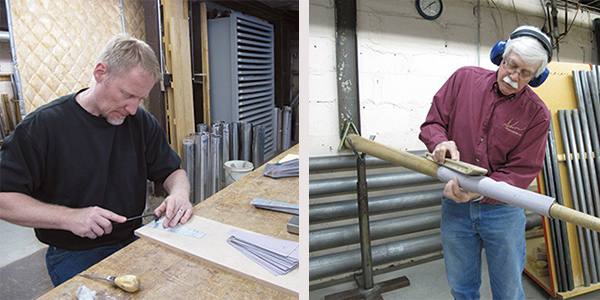
John Streufert (L) scribing mouths on the feet; Bill Ayers (R) rounding the bodies of the tapered Nasard 2-2/3′

As we invariably find, enthusiasm about a new pipe organ generates enthusiasm generally. Our design for an organ standing front and center, together with recommendations from acoustician Robert Mahoney, encouraged the parish to beautify its worship space by removing the carpeting and staining the concrete floor, refinishing the pews, and installing new LED lighting. The revised altar platform, now deeper and constructed of solid concrete rather than noisy plywood, is sheathed in gorgeous sedimentary stone, quarried near Jerusalem, in which fossils can be seen. A new communion railing by general contractor Tim Scherer and an ambo by liturgical artist Jeff Tortorelli complete the chancel.

Standing behind all this, the organ makes a commanding statement that draws attention to the front of the church rather than overwhelming it. To accommodate the choir, seated to one side of the chancel, the organ console is placed on that end of the case. From this location, the organist can easily give direction to the choir while remaining abreast of activity in the nave.

Director of music Steven Denmark, an organ performance student of Ladd Thomas (1966–72), had long dreamed of the form the organ would take, and together we explored many stoplists. But his thinking was dramatically changed by a 2014 visit to the organ in St. Michael’s Abbey in Farnborough, England. Installed in 1905 and attributed to Charles Mutin, the organ appears to contain older elements built by Mutin’s master, Aristide Cavaillé-Coll. Set within a small but acoustically stunning Gothic Revival chapel, this organ of only 14 voices makes an unforgettable impression, which I myself experienced during a visit shortly thereafter.

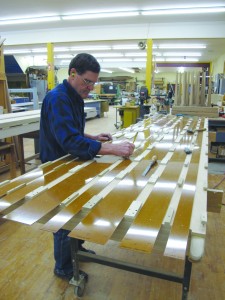
Randy Hausman fitting sliders to the Recit windchest

Encouraged by the possibilities on display in the Farnborough organ, essentially a one-manual instrument divided over two keyboards, the design of Opus 94 took a new turn. Although improved and now proportional to the space, the acoustic of St. Dunstan’s Church is but a pale shadow of that at Farnborough. However, a foundation-rich design as exemplified by the Farnborough organ is not only an appropriate response to a less-reverberant room but also a musically responsible choice for a parish with a traditional choral program. In Opus 94, nine of the manuals’ 15 stops are of 8′ pitch. For dynamic flexibility in both accompaniment and literature, the Plein Jeu and manual reeds stand within the Récit enclosure. Steve Denmark felt strongly that some sort of jeu de tierce registration should be present. There is no precedent in the work of Cavaillé-Coll for an independent Tierce, and when a stop of 22/3′ pitch was included, it was always a Quinte. We elected to make both mutations as flutes with strongly ascendant trebles, so that they function well with the principal-toned unisons. A Bourdon 16′ shared between Grand-Orgue and Pédale is a feature of most Cavaillé-Coll choir organs that I didn’t feel we could replicate here; the poor bass response of the church dictates a scale and treatment for the Pédale that would have muddied any manual texture.

Most of the pipes were built in our shop; the pipes of high tin alloy—the facade pipes, strings, and reeds—are the work of Killinger in Freiberg am Neckar, Germany. All are voiced on a wind pressure of 70 mm, regulated by a large, weighted, single-rise reservoir. The key action is balanced, running from the console to transverse rollers just above the floor that are fitted with crank arms for the pulldowns. While not a historic feature, the coupling manual offers useful registrational possibilities beyond the common II/I coupler.

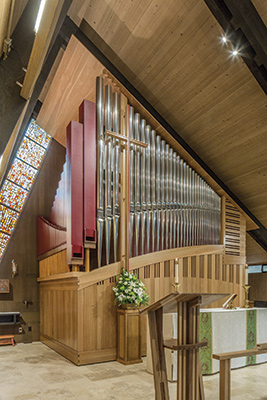
The angled geometry of the church interior called for a similarly nontraditional case design. In the facade, the pipes of the Montre 8′ make a bold, sweeping gesture, echoed by slotted openings at the level of the manual windchests. The instrument’s white oak case 
is crowned by a sheltering roof whose slope parallels the ceiling above. Despite its modern appearance, the instrument is laid out in a traditional way, with the Grand-Orgue standing immediately in front of the Récit. The Pédale Soubasse pipes, painted our customary “Dobson red,” form a wall at the end of the case opposite the console. Mechanism is present for the eventual installation of a Pédale 16′ reed.

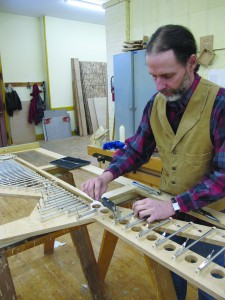
Randall Wolff fitting rollers for the mechanical key action

From the first, the members of St. Dunstan’s parish took an unusually active role in supporting the organ proj­ect, organizing creative fundraisers and spending many hours in renovation tasks. Central to this effort was the leadership of the Rev. Rob Fisher, rector of St. Dunstan’s, and Steve Denmark, who together worked tirelessly to generate interest in the project, not only from within the parish but also from the Monterey Peninsula community. Support came in various forms, including members providing lunch for the installation crew and voicers, and comfortable lodging on the estate of George and the Rev. Marcia Lockwood, once owned by Hank Ketcham, creator of “Dennis the Menace.” The ruggedly beautiful scenery of the Valley, Carmel Bay, and Big Sur was not 
directly provided by the parish, of course, but was a powerful inspiration to us nonetheless.

Parishioner Lee Collins, whose advocacy for a pipe organ long predated the arrival of Fr. Rob and Steve, passed away in December 2015 at age 93. He lived to hear and see his dream come to fruition, and would be delighted to know that the flowers for his funeral are in the photo on this month’s cover. He and his fellow parishioners understood the beauty of appropriate scale, now a counter-cultural concept in our world of giant televisions in modest living rooms, snacks that have the calories of entire meals, and electronic organs that think they are cathedral instruments. They recognized that something of appropriate scale could be imbued with craft, beauty, and timelessness. We are gratified that St. Dunstan’s Church chose us to realize this vision, which will, God willing, bring together worshipers and music lovers for generations to come.

John A. Panning is vice president and tonal director of Dobson Pipe Organ Builders.

View the stoplist

Dobson Pipe Organ Builders

William Ayers
Abraham Batten
Kent Brown
Lynn Dobson
Randy Hausman
Dean Heim
Donny Hobbs
Ben Hoskins
Arthur Middleton
John Panning

Kirk Russell
Bob Savage
Jim Streufert
John Streufert
Jon Thieszen
Pat Thieszen
Sally Winter
Randall Wolff
Dean Zenor

Last Modified on March 21, 2016

Award-winning Sept Hommages Performed at IUP; Available for viewing on YouTube

Claude Baker won the first Ronald G. Pogorzelski and Lester D. Yankee Annual Competition. His commissioned piece, Sept Hommages, premiered March 13th at 3:00 pm on the Pogorzelski-Yankee Memorial Organ at Indiana University of Pennsylvania. Kola Owolabi performed.

The general public was able to watch an interview with Dr. Baker and Dr. Owolabi’s performance through a live stream from IUP. A recording of Dr. Baker’s interview is currently available on the IUP YouTube channel. A recording of Dr. Owolabi’s performance will be available shortly.

View the IUP YouTube channel.
View the full program guide
Learn more about Claude Baker and the AGO’s newest competition.

Last Modified on February 12, 2021

2016 Gala Honors Wilma Jensen

The American Guild of Organists (AGO) selected internationally acclaimed organist, church musician, and teacher WILMA JENSEN as the honoree for the 2016 AGO Endowment Fund Distinguished Artist Award Recital and Gala Benefit Reception on Friday, April 8, 2016, in Nashville, Tenn. Complete information can be found.

The celebration began at 7:00 p.m., at West End United Methodist Church, 2200 West End Avenue, where the honoree performed a free recital featuring works by Vierne, Philip James, Franck, Brahms, Schumann, and Tournemire. Dr. Jensen was joined by Stephen Seifert in a performance of Conni Ellisor’s Blackberry Winter, a concerto for dulcimer and string orchestra, which was transcribed for organ by the honoree for this occasion. The Recital was followed by a Gala Benefit Reception at the Vanderbilt University Club of Nashville.

If you were unable to attend the Gala you can still participate from a distance by making a contribution to the AGO Endowment Fund in honor of Wilma Jensen. Contribute online (see link below) or by sending a check to: AGO Endowment Fund, 475 Riverside Drive, Suite 1260, New York, NY 10115.

All proceeds from the Gala will honor Wilma Jensen in perpetuity through the AGO Endowment Fund. For further information, please call 212-870-2311, ext. 4308, or e-mail gala@agohq.org.


Last Modified on February 25, 2016

Application to host a Pipe Organ Encounter-Technical (Builder)

Before starting this form, please be sure you have at the ready the following items needed for upload during the application process:

  1. A digital file (.PDF, .rtf, .doc, etc.) of a brief history of the organ building firm making the application
  2. All names of proposed faculty or staff from the firm’s staff
  3. A digital file (.PDF, .rtf, .doc, etc.) of a tentative schedule of activities for your POE Tech
  4. A digital file which is a scan of the “Statement of Approval” signed by the owner/president of the firm. (Form is found on the third page of Section 6.1.2 of the POE Handbook.)

Last Modified on May 9, 2017

March 2016 TAO Cover Feature Article

St. Monica Catholic Church, Dallas, TX
Nichols & Simpson Inc., Little Rock, AR

By Jeremy Wirths

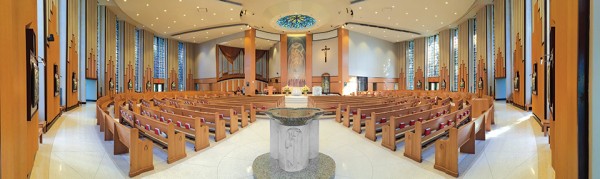
Panoramic view of St. Monica's round architecture design.
Panoramic view of St. Monica’s round architecture design.

St. Monica Catholic Church in Dallas, Texas, founded in 1954, is a large parish of around 14,000 parishioners, with an average of 4,000 individuals attending seven weekend Masses, and a proud heritage of education: St. Monica School maintains an enrollment of more than 850 students in grades K–8.

The parish has ten choirs and ensembles that provide leadership for the various Masses in both English and Spanish. The church building and organ are used for several school choral liturgies each week, along with many special performances, including organ recitals, and numerous musical presentations by outside ensembles.

In 2012, the parish began a major renovation of the church building, which had not been updated since its construction in 1965. The church’s dry acoustics had, for decades, been an impediment to music making. The previous organ, a 1968 three-manual Wicks of 47 ranks, was limited by its small scaling and stylistic inflexibility. The parish contracted consultants Scott Riedel and Associates of Milwaukee, Wisconsin, to work with the architectural firm Fischer Heck in designing interior features that extensively improved the acoustical environment of the church.

Nichols & Simpson four-manual console

Scott Riedel’s goal was “to hear clear and intelligible speech throughout the room, to assist musicians in developing well-balanced, blended, and projected music, and especially to enable the assembly to hear each other for wholehearted participation in sung and spoken parts of the liturgy.” Riedel’s obstacles were evident: thick red carpeting, concave-circular wall forms and a textured ceiling covered with sound-absorbing asbestos, and thin wood lattices and walls. The choir and organ were hidden behind wooden lattice work that had once served as a silent protest in the early days of Vatican II.

Riedel set out to create subtle, attractive design elements that would achieve his acoustic goals. The church’s greatest permanent acoustical challenge is its round shape, causing sound to reverberate back into the center focal point rather than mix and distribute. For this reason, the Riedel design includes what he has called “a sound supportive ceiling deck [to] allow tone to blend in the room, and the custom-designed acoustic wall panels between glass facets [to] diffuse, reflect, and temper sound in proper proportion.” Other acoustical improvements, as described by Riedel, include “new hard surface flooring throughout the room to reinforce and reverberate music and sung and spoken participation by the assembly. The sound obstructing lattice wall has been removed from the choir and organ space, allowing unimpeded tonal egress to the assembly. The facade of organ pipes and hardwood diffusers on the wall behind the choir singers also function to mix and project music throughout the room.”

In consultation with Riedel, and under the leadership of director of music Jeremy Wirths and organist Guillermo Martinez, St. Monica’s organ committee decided that a large American Classic instrument would best serve the musical needs of the par­ish. They identified choral accompaniment as a priority; the small dynamic range and lack of ensemble reeds of the previous instrument had been a hindrance to St. Monica’s music for decades. The musicians of the parish felt that a movable console would be absolutely necessary, as the church’s music space required flexibility for various ensembles.

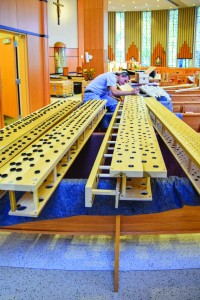
Nichols & Simpson crew preparing toe boards

The organ committee selected Nichols & Simpson Inc. of Little Rock, Arkansas, to build the new instrument. The committee was impressed by the diversity of design and tonal beauty found in the firm’s previous instruments, and they recognized that the unique modern architecture of the church would require design creativity on the part of the chosen builder. After months of work, a final plan emerged that included 54 stops and 71 ranks of pipes, with digital ranks included in order to maximize use of chamber space. There are 4,218 pipes.

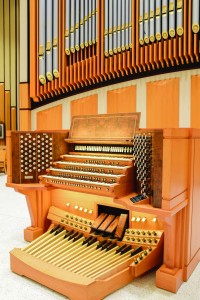
The organ is played from a four-manual mov­able console, the shell constructed of oak to match the other furnishings of the church, and the interior of burl walnut. The manual keys are polished bone and rosewood, the pedals are maple and rosewood, and the drawknobs are rosewood with engraved bone faces. The combination action features 256 levels of memory, a MIDI sequencer, and USB port to back up the settings.

The Swell division, located on the left side of the organ chamber, features warm flute stops, three luscious strings/celestes, an extensive reed chorus, and an independent 4′ celeste. The boisterous character of the independent 8′ Trompette and the smoother English-styled 8′ Trumpet allow two distinct reeds on which to build a reed chorus. The division includes a full principal chorus, as well as a cleverly split Plein Jeu.

The Great division is located in the center of the organ chamber with a principal chorus built on the 16′ Double Diapason, that makes up the facade.

The Choir includes two celestes and a full array of chorus and solo reeds. The Petite Trompette serves as a well-balanced chorus reed for accompanying, while the Trombas provide pungent reeds for French literature or solo reeds to cut through a full ensemble.

The pipes of the Pedal division are spread throughout the chamber, with the largest pipes reaching from floor to ceiling behind the Swell pipes. The 16′ Open Wood is an impressive foundation for the large space of St. Monica Church. Three digital 32′ stops are effectively voiced, saving space in the chamber and filling out this solid division.

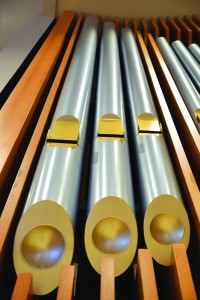
Facade pipe details
Facade pipe details

The Solo is located behind the pipes of the Great and features a commanding Tuba stop, as well as a solo Flute stop at 8′ and 4′, and a string and celeste. Because of space constraints, the English Horn and French Horn are digital stops.

Other features of the organ include a Cymbelstern (comprised of eight small Malmark handbells), a Rossignol, and harp, celesta, and chimes supplied by Walker Technical Company.

The case was designed by Frank Friemel. R.A. Colby fabricated and installed the wooden portions of the case comprising 84 individual pieces attached to an iron framework. A.R. Schopp’s Sons worked diligently with Nichols & Simpson and Frank Friemel to make the distinctive case pipe designs a reality.

Organist Guillermo Martinez stated, “This new pipe organ is indicative of the investment of energies and talents to keep traditional church music alive and vibrant for not only the parish, but also for the Dallas music community.” St. Monica is proud to have been selected to host a recital during the 2017 AGO Regional Convention in Dallas.

Since the dedication of the instrument two years ago, the parish’s liturgical music has been profoundly enriched by this stunning new instrument. The Rev. Stephen Bierschenk, pastor of St. Monica since 2008, has been delighted by the high level of interest and enthusiasm the organ has created. Of this new spirit he has written, “This beautiful organ gives voice to our desire to honor God in the best ways possible. As our soul is stirred by the beauty of a hymn, and we are thrilled by the majestic tones of an anthem, our hearts and minds are reminded that God has given us so many ways to express our joy in his gifts.”

View the stoplist

Jeremy Wirths holds degrees from the University of Kansas, Emory University, and the University of North Texas. He served his first parish as a musician when he was 15 years old, and has served a total of seven parishes in four states.

  • « Go to Previous Page
  • Page 1
  • Interim pages omitted …
  • Page 41
  • Page 42
  • Page 43
  • Page 44
  • Page 45
  • Interim pages omitted …
  • Page 57
  • Go to Next Page »

Primary Sidebar

Footer

Lessons for the New Organist

Connect

  • Facebook
  • Instagram
  • LinkedIn
  • Pinterest
  • Twitter
  • YouTube

Search

Search help:

Put double quotation marks around multi-word searches. Hit Enter to process.

Mission Statement

The mission of the American Guild of Organists is to foster a thriving community of musicians who share their knowledge and inspire passion for the organ.

Achievement Awards
AGOYO
Antitrust Compliance
Ask the Organbuilder
Change of Address
Chapter Deans Contact
Chapter Documents
Chapter Liability Insurance
Chapter Toolkits
Classified Ads
Contact Us
Find a Job
Find an Organ Teacher
Guild Documents
Insurance for AGO members
Pipe Organ Encounters
Post a Job
Privacy Policy
Salary Guidelines
Strategic Growth Plan

PROFESSIONAL LINKS

Organbuilders & Associations
OrganLive
Other Organ and Choral Music
Other Professional Associations

Pipedreams
Vox Humana

Don’t Fall for Scams

Scammers are everywhere and chapter officers need to be vigilant. Don't respond to requests to send funds unless you know for sure that the request is valid.
American Guild of Organists 475 Riverside Drive, Suite 1260 New York, NY 10115
Hours of Operation: 9 a.m. - 5 p.m. M-F ET
Phone: (212) 870-2310
Email: info@agohq.org
© 2024 American Guild of Organists
Major support for this website was provided by the New York City AGO Chapter’s Centennial Millennium Fund.
GDPR CONSENT: The American Guild of Organists uses cookies on this website to give you the most relevant experience by remembering your preferences and repeat visits. By clicking “Accept” you consent to the use of cookies.
Cookie settingsACCEPT
Manage consent

Privacy Overview

This website uses cookies to improve your experience while you navigate through the website. Out of these, the cookies that are categorized as necessary are stored on your browser as they are essential for the working of basic functionalities of the website. We also use third-party cookies that help us analyze and understand how you use this website. These cookies will be stored in your browser only with your consent. You also have the option to opt-out of these cookies. But opting out of some of these cookies may affect your browsing experience.
Necessary
Always Enabled
Necessary cookies are absolutely essential for the website to function properly. This category only includes cookies that ensures basic functionalities and security features of the website. These cookies do not store any personal information.
Non-necessary
Any cookies that may not be particularly necessary for the website to function and is used specifically to collect user personal data via analytics, ads, other embedded contents are termed as non-necessary cookies. It is mandatory to procure user consent prior to running these cookies on your website.
SAVE & ACCEPT