• Skip to main content
  • Skip to primary sidebar
  • Skip to footer

American Guild of Organists

iMIS Site

AGOYO News

Last Modified on May 9, 2017

November 2016 TAO Cover Feature Article

Ebenezer Lutheran Church
Greensboro, NC
Parkey Organbuilders • Duluth, GA

By Phillip K. Parkey
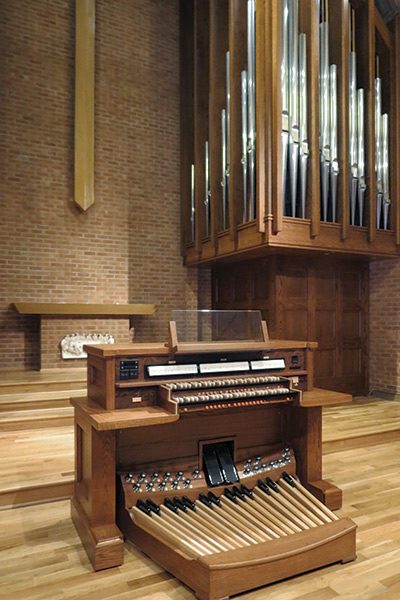
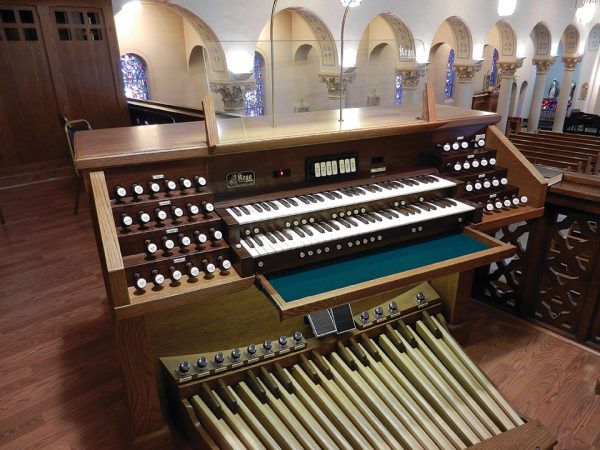
console-600x400px
Console

My initial contact with Greensboro’s Ebenezer Lutheran Church occurred approximately five years ago, when William Carroll was the chair of the music department at the University of North Carolina, Greensboro, and the organist/choirmaster at Ebenezer Lutheran Church. We had met Dr. Carroll through our working relationships with other organists in Central North Carolina. The church had a “compiled” organ that had been installed in the 1980s and had never been successful. They began to explore options for replacing the organ completely. Dr. Carroll had previously been in the selection process with two other organs in the Greensboro area. Dr. Carroll had served as the choirmaster/organist previously at Ebenezer and was petitioned to return again based on his past success.

When we met for the first time, he was clear that Ebenezer had a strong music program and a strong singing congregation. The church’s needs called for a well-balanced service instrument. The committee was familiar not only with our recent installation at Providence United Methodist Church in Charlotte, North Carolina, but also one of our first instruments at a church in Salisbury. The committee visited several organs in and around Greensboro and decided that our work met the needs of their congregation. In addition, the committee resoundingly enjoyed the sound of our work.
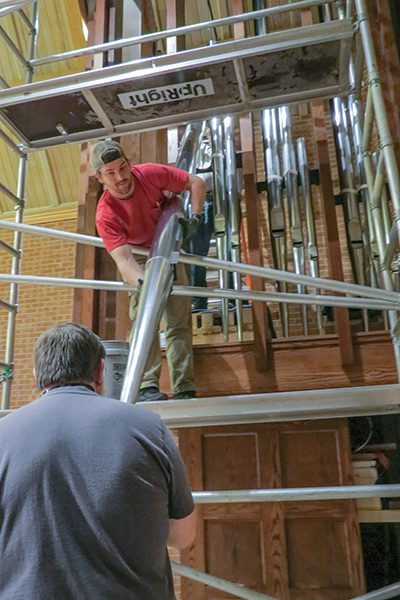
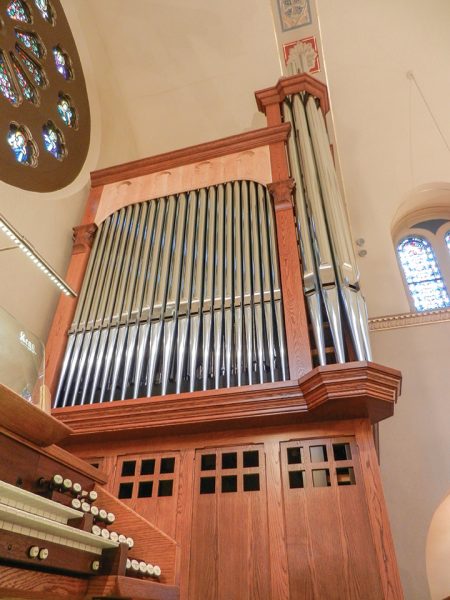
Installing facade pipes

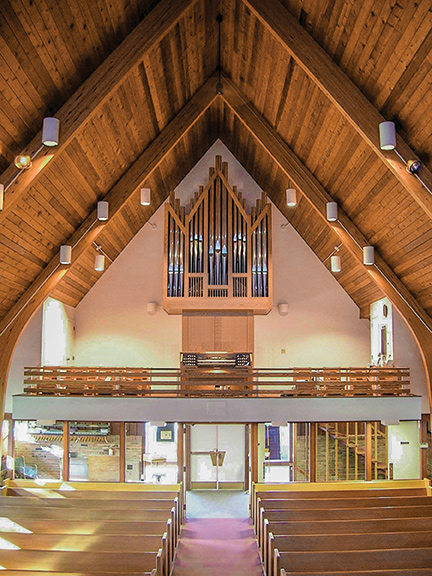
After several discussions with the committee, we were asked to design an instrument for the front of the room. The Swell division of the old organ was housed in a side chamber that never allowed adequate tonal egress and was far too deep and ill-suited for the new installation. The cross and the altar were to remain the focal point of the room, and we were asked to carefully consider the logistics of Communion distribution to the congregation. The logical choice was a divided case installation. In this, our Opus 15, the Great and Pedal are housed in the left case, and the Swell is enclosed in the right case. The old Swell chamber was reduced to a depth of three feet, and the lowest eight notes of the 16′ Contra Bass were installed horizontally in the shallow space. Our designer worked with the committee to arrive at a simple but elegant case design that preserved the stately feel of the room.

Our tonal staff provided a principal chorus of a rich commanding presence. The organ offers a great dynamic range from the luscious strings in their expressive swell box to the full chorus with a broad, fiery Trompette and an Hautbois at 16′ and 8′.

The church could not have been more delightful to work with and we enjoyed a great deal of attention from the clergy and congregation during the installation. The organ was finished and dedicated with its first use on Easter Sunday. Tonal Director Fred Bahr carefully set the balances of the organ and the results are simply marvelous.

As a member church of the Missouri Synod, Ebenezer has a rich musical heritage that includes strong Lutheran hymn singing. While supporting hymn singing the organ also needed to provide accompaniment for contemplative moments such as prayer and Communion. Even on Easter Sunday, the church paid homage to its roots by opening services with Martin Luther’s robust hymn “A Mighty Fortress Is Our God.” Upon hearing the organ during its inaugural services, I believe that the organ provided the full range of expression equally well.
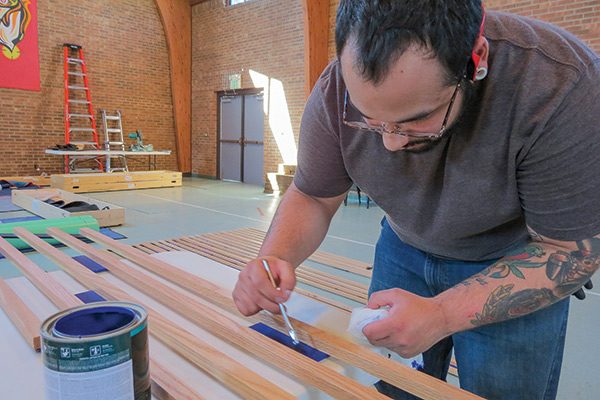
Touching up details of the pipe shades

As a builder, I often find that the smaller projects can provide not only great challenges but also great rewards when completed. The goal of organbuilding is not to provide more ranks or stops or to build huge cases; rather, it is to provide an instrument that meets the needs of the client. It is truly a blessing to see the people of the church enjoy the rewards of their efforts.

We are grateful to the organ committee of Ebenezer Lutheran Church and to William Carroll for their patience and confidence in our firm to provide the new pipe organ for Ebenezer Lutheran Church.

Phillip Parkey is president of Parkey Organbuilders.

The Organbuilders

Phillip Parkey, Fredrick Bahr, Chris Bowman, John Elliano, Otilia Gamboa, Ben Lewis, Jonathan Meeks, Michael Morris, Johann Nix, Philip Read, Kurtis Robinson, Keith Williamson

From the Organist/Choirmaster

I have been associated with Ebenezer Lutheran Church off and on since 1985. The congregation sings lustily, the choir is capable, and the new Parkey organ is a most welcome addition. It has been my pleasure to be a part of three organbuilding projects during my career. Two of those projects were, for the most part, funded by a generous single donor. That was not the case at Ebenezer Lutheran. Over a lengthy period of time the congregation grappled with whether or not to move forward on an organbuilding project. Amazingly, some months ago in a congregational meeting a longtime member suggested, “Folks, it’s time we got this thing done.” Near unanimous consensus was found, an organ committee was appointed, and the project moved forward with the support of the clergy and the lay leadership. There was broad support and “buy in” for the project throughout the congregation. The lovely new instrument is a testament to the “togetherness” we all experienced in bringing this instrument to our church and community.

William P. Carroll

From the Designer

The evolution of the design for the organ was driven by a continual attention to balance. The service requirements for a church with an enviable tradition of lusty hymn singing required an instrument of a certain size. The location of the previous instrument had never been ideal. Parkey OrganBuilders decided to explore the options for putting an instrument on the front wall on either side of the chancel, and the congregation was open to this as long as we could give them enough room that Communion would not seem crowded. We had also noted that ribbed brick walls to the side of the altar—the only noticeable architectural ornament to the room—gave an increased sense of verticality to the space and would now be completely covered. We wanted a design that would continue to give the room a sense of loftiness. We also wanted it to meet what is always our first criterion—that the organ look as though it had always been there; that it gave a sense of belonging in the space. The church did not want a design that would seem too formal, and they wanted the central cross to remain a focus.

A variety of options were discussed, but the final design was a universal favorite, and the congregation voted unanimously to proceed.

Michael Morris

Opus 15’s Tonal Design

From a tonal designer’s vantage point, a church organ of 25 ranks always presents a unique set of challenges, opportunities, and temptations. One can eschew all unification and produce a very respectable instrument that will do the job: solid independent principal choruses for leading congregational singing, a pair of strings for Communion, a flute or two with matching bass for accompanying a small choir, and a smattering of reed and mutation tone for color.

Another approach is to embrace the concept of unification and use it to give the organist an almost limitless number of choices in registering the available tonal resources. Both avenues have distinct advantages and pitfalls in the very real world of church music making, and both avenues are of course crowded with successful proponents and detractors.

At Ebenezer, we chose a moderate route, strongly favoring the traditions of classical organbuilding, but not ignoring the needs of the organist either. The stop-list does not break any new ground, opting instead for a utility shaped by years of effective service playing. Octave unification is limited primarily to the Pedal division where its shortcomings are less obvious. The Swell strings and Trompete available independently on the Great manual allow some flexibility in registering them against other Swell stops.

Like many organs of this size, this instrument owes a large measure of its success to its sense of tonal balance. Each stop contributes its own essential component to the overall sound, without neglecting the role it plays with its neighbors in smaller combinations. No single stop is extraordinarily loud or whisper-soft. An efficient swell box, with thick walls and carefully fitted shades, increases the dynamic range. The unenclosed Great easily carries the room on its own. The “caged rage” sound of full Swell smolders behind it with the shades closed, then matches it as the shades open. At full organ the sound is thrilling without assaulting the listener.

Organbuilding is a matrix of complex systems. Physical and tonal design, funding, engineering, structure, construction, scaling, placement, and acoustics—each play a critical role in creating organ sound. But it is the people involved that turn craft into art, science into magic, sound into music, and expense into lasting legacy. It has been our privilege to work with each other and the people of Ebenezer Lutheran Church to create an instrument that we hope will bring joy to all who see, hear, and play it.

Fredrick Bahr, Tonal Director
View the stoplist

Last Modified on October 11, 2016

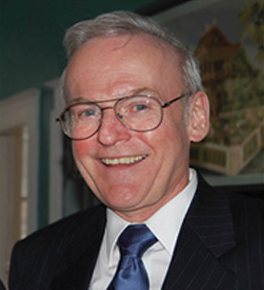
AGO Past President John Walker to be Honored at Concert

Concert to honor John Walker
John Walker

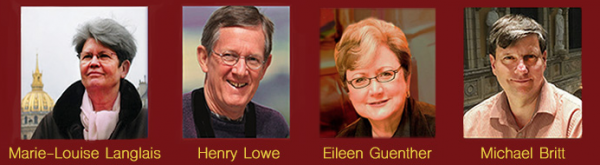
Organists Marie-Louise Langlais, Eileen Guenther, Henry Lowe and Michael Britt will present a concert honoring organist John C. Walker, immediate past president of the American Guild of Organists, on Sunday, November 6, 2016 at 3 p.m. at Brown Memorial Presbyterian Church in the Bolton Hill neighborhood of Baltimore, MD. They will be playing the church’s 1931 Skinner organ, Opus 839 (IV/45). Three choral works composed in Walker’s honor will also be performed.

The program includes works by Jean Langlais, Jehan Alain, Maurice Duruflé, Bruce Simonds, Robert Hebble, and Joe Utterback. Brown Memorial’s Chancel Choir will perform pieces by Daniel Gawthrop, Alfred Fedak and JoyAnne Amani Richardson. John Walker and JoyAnne Richardson, who directed the gospel choir when the two of them served together at The Riverside Church in New York City, will play organ and piano on the concert’s concluding work..

Marie-Louise Langlais was co-titular organist of the Basilica of Sainte Clotilde for many years with Jean Langlais, the renowned composer and organist. Widely celebrated for her “intensely musical playing, full of passion, and for her remarkable technique,” Mme Langlais has performed, lectured, and served on organ competition juries around the world. Emeritus Professor of Organ at the Paris Conservatory of Music, she recently published Jean Langlais Remembered, a musical biography of her late husband.

Eileen Guenther, three-term president of the AGO, is Professor of Church Music at Wesley Theological Seminary where she is also Director of Chapel Music. She has performed recitals throughout the United States, Europe, Asia and South America, and also conducts workshops on global music. Author of Rivals or a Team: Clergy-Musician Relationships in the 21st Century (2012), Dr. Guenther recently published In Their Own Words: Slave Life and the Power of Spirituals.

Henry Lowe recently retired after 32 years as Director of Music at Church of the Redeemer in Baltimore. His career as a church musician, recitalist, clinician, conductor and teacher has taken him to many parts of the this country and Europe. He has presented recitals at St. Paul’s Cathedral in London and the Cathedral of Notre Dame in Paris. Former dean of both the Cincinnati and Baltimore Chapters of the AGO, he also taught organ at Towson University and Goucher College.

Michael Britt is a frequent recitalist of classical organ music who has performed at the Cathedral of Notre Dame in Paris. He also performs theater organ music and is in demand nationally as a silent film accompanist. He recently accompanied “Phantom of the Opera” at Princeton University Chapel for the tenth time. In addition to being Minister of Music at Brown Memorial Park Avenue Church, Britt also serves as Assistant Organist at Beth-El Congregation and teaches at the Community College of Baltimore County. He is former Dean of the Baltimore AGO chapter.

walker-concert-organists
Walker concert participating organists

John Walker is Minister of Music Emeritus at Brown Memorial, having earlier served at Shadyside Presbyterian Church in Pittsburg and The Riverside Church in New York City. He is a member of the organ faculty at Peabody Conservatory of Music and distinguished Visiting Professor of Organ at the Shanghai Conservatory of Music. He has performed in the most distinguished venues throughout North America, Europe and Asia; he also has a noted discography. Before becoming AGO president, he served in many other capacities in the organization, including directing the Task Force which developed the first Pipe Organ Encounters.

Tickets to this Tiffany Series event are $20 general admission, $50 Patron level, and $10 students. Parking and shuttle service will be available. For more information, call 410-523-1542 or email.

The Tiffany Series is named for the historic Bolton Hill church’s unparalleled collection of 11 original Tiffany stained glass windows. Brown Memorial is wheelchair accessible.

Last Modified on May 9, 2017

October 2016 TAO Cover Feature Article

Three Small Pipe Organs
Kegg Pipe Organ Builders • Hartville, OH

By Charles Kegg

Sacred Heart Church New Philadelphia, OH

The desire of every organist is to play a pipe organ, Mozart’s King of Instruments. With the extensive publicity that large pipe organs can receive, many congregations believe they cannot consider a pipe organ due to limited space or budget. Typical parish churches need an instrument that can support congregational singing, accompany the choir, and play service music and a moderate range of organ literature; organ recitals are rare events. A properly designed and executed pipe organ of modest size can serve these needs well. With this in mind, our firm has spent considerable time developing instruments that are interesting to play, attractive to listeners, and affordable to purchase and maintain. Regardless of size, all of our pipe organs have the same hallmarks of quality such as solid wood construction, recessed panels, comprehensive combination systems, bone and rosewood keys, and unmatched client care.

Sacred Heart Church, New Phiadelphia, OH
Sacred Heart Church, New Philadelphia, OH

We start with a clean slate and a clear goal. We want an instrument with maximum flexibility and minimum compromise to pull the most utility from the resources available. We take advantage of modern mechanical design and control systems. Each stop is considered, scaled, constructed, and voiced for its multiple duties. The pipe treatment is often different from that of the same stop in a straight organ design, in order to negate the “unit” sound such organs frequently exhibit. While these Kegg instruments are unit organs, they are not like typical unit organs where every rank is played at many pitches. The result is an instrument that feels, plays, and sounds like a larger instrument, and the unification is musically invisible. In these designs, the 8’Principal is unenclosed while all the remaining manual stops are enclosed in a single expression box. All enclosed stops are then available on both manuals, carefully considered, for the best artistic results. The unenclosed Principal is important to allow one to “step out of the box,” while retaining maximum dynamic control of the balance of the organ.

A significant consideration for a pipe organ is, where will it go? We have been told frequently that a room has no space for a pipe organ only to discover that in fact it does. We have a nine-rank organ in Pleasantville, New York, that hangs from the roof over a choir loft. One must never underestimate the ingenuity of a pipe organ builder. While a smaller instrument can be divided between more than one location, a single location gives the greatest cost efficiency. We always take the entire music program into account when we design a new pipe organ to allow it to benefit all the musicians that will use it as well as the congregation that will be inspired by it. The organ case or chamber position needs to allow the organ to be used with the choir and not to overpower it.

Our basic design for these smaller instruments works well for organs ranging from seven to 15 ranks. As the instruments become larger they become closer to the straight ideal and can be more conventional in design. Here are described three examples of organs we have built on our small organ concept. These range in price from $182,000 to approximately $475,000, depending on size and installation parameters such as case design and decoration. Given that costs for an electronic instrument can easily exceed $150,000, these numbers are reasonable.

kegg_st-katherine-mich-72dpi
St. Katherine’s Episcopal Church, Williamston, MI

The first example is an organ built for St. Katherine’s Episcopal Church in Williamston, Michigan. This church seats approximately 150 and enjoys a quiet country setting. The modest choir and Anglican tradition calls for color and wide dynamic range. The organ has eight ranks of pipes and includes two reed stops, one of which extends to 16′ pitch in the Pedal. Upper work is of less priority in this small room so the “mixture” is actually derived and is provided for color. The Principal and Octave, which are separate, are key to the success of this design. If you study the stoplist you can see that with manuals uncoupled, many normal registrations are largely or completely straight. The basic needs of a typical American church are enhanced with the addition of a Celeste and two reed stops, not usually found on instruments of this size. Note that the off-unison stops are taken from the independent Quinte rank. This is vitally important for proper tuning and goes a long way to removing the “unit sound” from this organ. This is a priority for us and we never draw an off-unison stop from a tempered unison stop. This organ can do quite well in a room of 200 seats, and with a good acoustic and placement it will do well even in a larger room.

The next example is St. Philip the Apostle Church in Cheektowaga, New York. Here the goals are to support congregational singing and fill a larger room of 450 seats in an acoustic that is not quite ideal. This twelve-rank organ has a straight principal chorus of 8′-4′ -IV on the Great. The single reed stop is a Trumpet of moderate aggression that extends to 16′  in the Pedal. Of note here is the presence of two flute stops:  Rohrflute and Spitzflute. These stops are about equal in volume but quite different in color. The milky sound of the Spitzflute in the lower range gives it the illusion of softness due to its color. With shades closed, this stop becomes subtle. Its growth in the treble makes it work as a sparkly 2′ stop. The two flutes are available at 8′ and 4′ on both manuals, but inverted so that the two manuals have different 8′ and 4′ flute combinations. Because the Swell does not have a Mixture, there is a 2′ principal stop and a 1 1/3′ stop to give it the ability to provide a secondary chorus without the use of reeds. This organ easily fills this typical modern room while retaining the ability to subtly accompany a trained choir.

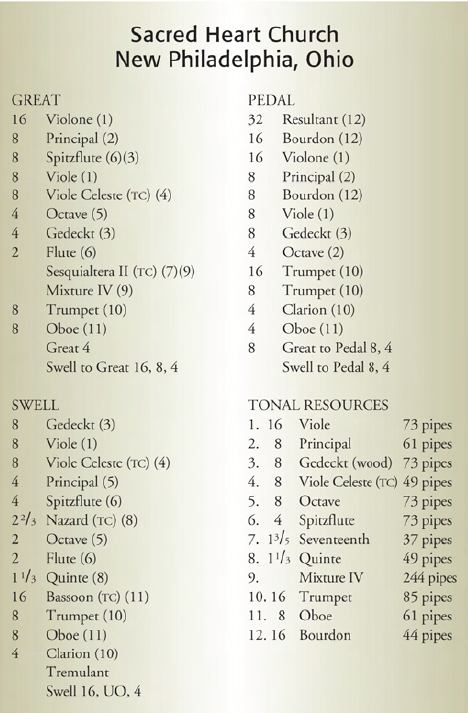
Our third example is Sacred Heart Church in New Philadelphia, Ohio. This room seats approximately 400 and enjoys a fine acoustic with ideal organ placement. Here we have a 15-rank organ with all the resources seen before with the addition of a 16′ Violone extension, Sesquialtera, and (finally!) an unenclosed independent Pedal 16′ Bourdon. The 37-pipe 1 3/5′ Seventeenth is combined with the lowest 37 pipes of the first mixture rank to make the Great Sesquialtera, giving a strong leading voice at modest cost and taking little space. This allows the Quinte to be of moderate volume to provide a gentle Nazard that grows in the treble to make a sparkly Larigot. The importance of the enclosed 16′  Violone cannot be overstated. It gives an added dimension to this organ, impressively helpful on both manual and pedal. The Violone also allows the independent Bourdon to be full and firm throughout its compass. This organ is the logical conclusion to this concept of shared resources and it plays a lot of music. Liturgical needs are met and discoveries are always being made as one finds unusual ways to bring new sounds to life.

Compromise? Of course. The ideal is always a completely straight pipe organ, but with thoughtful design and construction we can provide a pipe organ that is satisfying to musician and listener. It will be more gratifying to play than an electronic imitation, and with a life span many times that of an electronic, these fine pipe organs will actually cost less over time than a series of organ facsimiles that are replaced every 20 years.

We are all charged with being good stewards of the monetary resources of our clients/employers. For the wise and forward-looking congregation, there is no more musical choice and no more responsible financial choice than a fine pipe organ.

View the stoplists:

St. Philip the Apostle
St. Katherine’s Episcopal Church
Sacred Heart Church New Philadelphia

Charles Kegg is president and artistic director of Kegg Pipe Organ Builders, which he established in 1985. A member of the Associated Pipe Organ Builders of America, he trained for eleven years with Schantz, Casavant, and A.R. Schopp’s Sons, and was responsible for the final voicing of many Schantz and Casavant instruments ranging in size from four to 132 ranks.

Last Modified on October 3, 2016

2015 Pittsburgh Regional Convention Videos Now on YouTube

In the summer of 2015 the AGO Mid-Atlantic Regional Convention in Pittsburgh hosted performances by organists Nathan Laube, Elise Smoot, Marvin Mills, Brian Harlow, Christopher Jennings, and vocalist Marlissa Hudson. The performances, nine in all, were video-recorded and are now available in a playlist on the AGO’s YouTube Channel.

Totaling more than two hours of performance, these high-quality videos feature the organs of Calvary Episcopal Church, Duquesne University, Shadyside Presbyterian Church, and St. Paul Roman Catholic Cathedral. Narrated by WQED’s Jim Cunningham, the videos showcase several impressive examples of church architecture in Pittsburgh.

Members of the AGO’s Pittsburgh chapter provided logistical and financial support for this project. Linda Everhart worked tirelessly to see the project to fruition. Thank you, Linda.

Watch the Pittsburgh 2015 Convention videos.

Last Modified on September 29, 2016

Church Music Institute Creates eLibrary of over 10,000 Sacred Choral Titles

In 2015, conversations began about the possibility of the CMI eLibrary becoming a membership benefit to members of AGO. Funding was sought and obtained for a pilot project; considerations among the appropriate levels of approval needed within AGO were initiated and completed. In early 2016, a pilot project for CMI and the AGO to offer access to the eLibrary was begun through the national office to chapters in Kansas City, Indianapolis, and Atlanta.

Enrollment processes were honed, and access was provided; at this writing, dozens of AGO members and their colleagues are experimenting with the eLibrary as we look forward with hope to offering all AGO members this benefit in 2017.

pdf-large-typePlease read  the full article in the July 2016 issue of TAO by CMI Executive Director Charlotte Kroeker

Last Modified on September 8, 2016

Atlanta, Georgia hosts one of 8 Pipe Organ Encounter events in 2016

Atlanta, Georgia was the site of a POE directed by Nicole Marane, director of the AGO National Committee on Pipe Organ Encounters. The students were photographed  from the chancel of Peachtree United Methodist Church in Atlanta. A full report of this and other Pipe Organ Encounter events will appear in the December, 2016 issue of The American Organist. (PHOTO CREDIT: Bush Enos)

  • « Go to Previous Page
  • Page 1
  • Interim pages omitted …
  • Page 35
  • Page 36
  • Page 37
  • Page 38
  • Page 39
  • Interim pages omitted …
  • Page 57
  • Go to Next Page »

Primary Sidebar

Footer

Lessons for the New Organist

Connect

  • Facebook
  • Instagram
  • LinkedIn
  • Pinterest
  • Twitter
  • YouTube

Search

Search help:

Put double quotation marks around multi-word searches. Hit Enter to process.

Mission Statement

The mission of the American Guild of Organists is to foster a thriving community of musicians who share their knowledge and inspire passion for the organ.

Achievement Awards
AGOYO
Antitrust Compliance
Ask the Organbuilder
Change of Address
Chapter Deans Contact
Chapter Documents
Chapter Liability Insurance
Chapter Toolkits
Classified Ads
Contact Us
Find a Job
Find an Organ Teacher
Guild Documents
Insurance for AGO members
Pipe Organ Encounters
Post a Job
Privacy Policy
Salary Guidelines
Strategic Growth Plan

PROFESSIONAL LINKS

Organbuilders & Associations
OrganLive
Other Organ and Choral Music
Other Professional Associations

Pipedreams
Vox Humana

Don’t Fall for Scams

Scammers are everywhere and chapter officers need to be vigilant. Don't respond to requests to send funds unless you know for sure that the request is valid.
American Guild of Organists 475 Riverside Drive, Suite 1260 New York, NY 10115
Hours of Operation: 9 a.m. - 5 p.m. M-F ET
Phone: (212) 870-2310
Email: info@agohq.org
© 2024 American Guild of Organists
Major support for this website was provided by the New York City AGO Chapter’s Centennial Millennium Fund.
GDPR CONSENT: The American Guild of Organists uses cookies on this website to give you the most relevant experience by remembering your preferences and repeat visits. By clicking “Accept” you consent to the use of cookies.
Cookie settingsACCEPT
Manage consent

Privacy Overview

This website uses cookies to improve your experience while you navigate through the website. Out of these, the cookies that are categorized as necessary are stored on your browser as they are essential for the working of basic functionalities of the website. We also use third-party cookies that help us analyze and understand how you use this website. These cookies will be stored in your browser only with your consent. You also have the option to opt-out of these cookies. But opting out of some of these cookies may affect your browsing experience.
Necessary
Always Enabled
Necessary cookies are absolutely essential for the website to function properly. This category only includes cookies that ensures basic functionalities and security features of the website. These cookies do not store any personal information.
Non-necessary
Any cookies that may not be particularly necessary for the website to function and is used specifically to collect user personal data via analytics, ads, other embedded contents are termed as non-necessary cookies. It is mandatory to procure user consent prior to running these cookies on your website.
SAVE & ACCEPT